Mahendralal Sircar
The second M.D. the country ever produced, who burned a golden practice on principle — and spent the insurance on a farm for talent he knew he would not live to harvest.
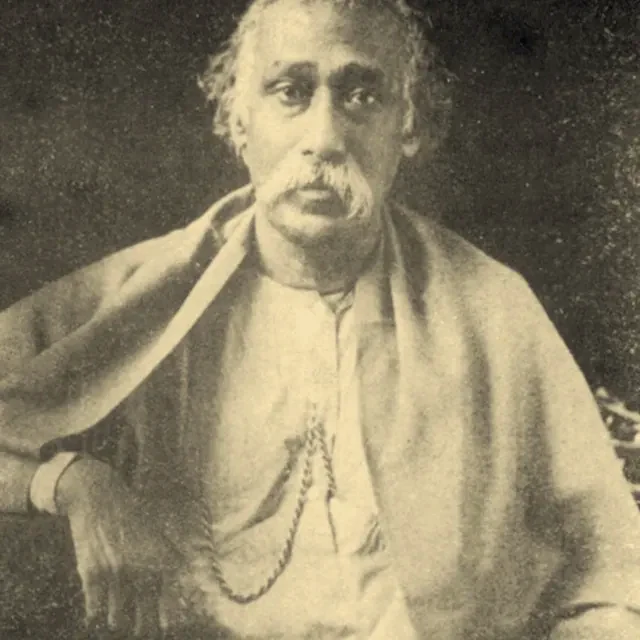
The loud heresy
Start from the top of the mountain, because he was standing on it. Orphan boy, free seat at Hare School, second Indian ever to take an M.D. from Calcutta University, the most consulted physician in the city — and in 1867 he stands up in public and recants the medicine that built him, for homeopathy, a school he himself had mocked on the record. The city calls it what it looks like: professional suicide on purpose. The establishment answers by name, from the lecture stage. The golden practice thins.
And here is the thing the outrage missed. The homeopathy was only the loud part. The quiet heresy was the idea underneath it — that an Indian should not spend his life merely receiving the science Europe deigns to send. Once a man has said that out loud to himself, the rest of this page is inevitable.
The episode — The Heretic DoctorThe farm at 210 Bowbazar Street
He campaigns year after year for a research institution owned, funded and run by Indians — and on 29 July 1876, in a rented house at 210 Bowbazar Street, it opens: the Indian Association for the Cultivation of Science. Not a rupee from the government, not a rupee from abroad. Public subscription, Indian money, his own money. “Solely native, purely national” — his words, and he priced them personally.
Then he does the unglamorous decades. A hundred-plus public lectures with three hundred people a night, a Belgian Jesuit physicist teaching beside the Bengali heretic, the city half-mocking it as the “Private College of Science.” He is not building a monument and he knows it. He is digging soil for a crop whose faces he will never see — hold the fort with one hand, sow the next crop with the other, and do not wait for a harvest you won’t be at.
The episode — The Temple at BowbazarWrong about only one thing
He dies in 1904 counting what he couldn’t build. The endowed chairs never came, the money for greatness never came, and by his own arithmetic the bet had failed. Now run the film forward twenty-four years, into his own rooms: February 1928, a clerk-turned-physicist named Raman, working on improvised equipment in the Bowbazar house, watches a sliver of light come out the other side changed — and in 1930 that light lands in Stockholm as the subcontinent’s first science Nobel. Won inside the heretic’s house, on Indian instruments, fifty-four years after he switched on the lamp.
Sircar was right the whole time. He just had the bad luck to be right too early to see it — which, if you think about it, is the job description he wrote for himself.
Where this thread runs
A life, dated
- 1833Born; orphaned; educated on a free seat at Hare School.
- 1863Second Indian to take the M.D. of Calcutta University; rises to the top of the city’s practice.
- 1867Recants allopathy in public; the establishment answers by name — S1 · E2.
- 1876Founds IACS at 210 Bowbazar Street, 29 July — public money only — S1 · E5.
- 1876–1904A hundred-plus public lectures; three hundred listeners a night; the farm holds.
- 1904Dies convinced the bet failed.
- 1928–30Raman’s light, in Sircar’s rooms, becomes the first science Nobel of the subcontinent — S3 · E6.
Named sources
- The episode record, The Heretic Doctor (S1 · E2) — the 1867 recantation and its price.
- The episode record, The Temple at Bowbazar (S1 · E5) — IACS founding, 29 July 1876, funding model.
- Primary and period sources, named in full on each episode’s own source list.
House rule: numbers arrive with their author’s name attached, and we correct in public. The method is on the About page →