Start with the number, because the whole man is hiding inside it.
Bose comes back from Cambridge thrice armed with good degrees, takes the physics post at Presidency College, and the government works out what to pay him. Not what they pay an Englishman in the same chair doing the same work. A third of it. There is a logic, written down somewhere in an office in a hand that has never met him: a native is a native, and you do not pay the help a gentleman's wage.
So he does the strange thing. He does not write to the papers. He does not resign in a temper and become a story other people tell. He simply does not take the money. For three years he teaches, he marks the scripts, he runs his classes — and at the end of every month, when the reduced salary is offered, he declines to draw it. Three years of a man going to work and refusing to be paid wrongly for it, on the quiet, with no audience. The house runs on Abala's economy and whatever was put by, and he holds the line until the College gives way and pays him in full, with the three years of arrears behind it.
He would rather take nothing than take an insult dressed as a wage.
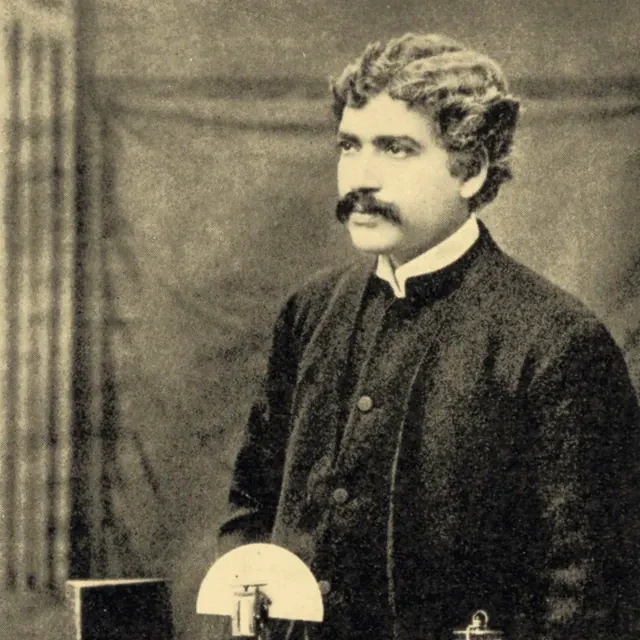
Now look at what he does with the lab.
He wants to work on electric waves — the very short, invisible kind — and he needs instruments. In England a man writes to a firm and the instruments arrive in a crate. In Calcutta there is no firm. There is no instrument industry, because the whole arrangement of the country is designed so that India buys finished things from Britain and sends back raw ones. A scientist in a colony is meant to be a grateful consumer of apparatus, the way the country is a consumer of cloth.
So Bose sits down with a local tinsmith — a man who has never made a scientific instrument in his life — and teaches him, and between them they build the apparatus by hand, out of what can be had. He makes his own receiver. He makes the thing he and others call the Coherer. The country won't sell him tools, so he manufactures the tools, and then he manufactures the science.
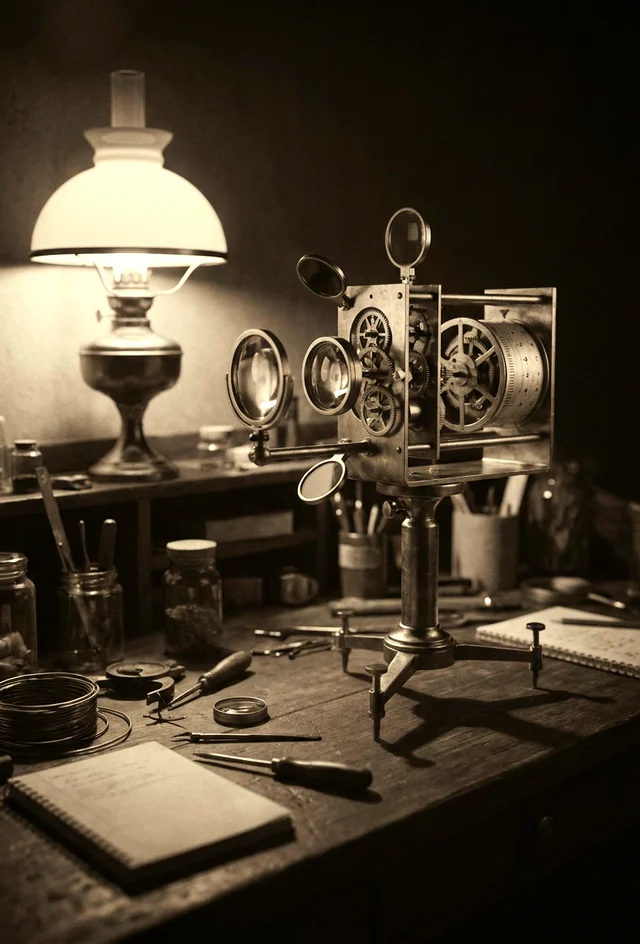
And then, in 1896, he carries it into the lion's own house. Picture the Royal Institution in London — the room where Faraday lectured, the cathedral of British physics — and a colonial subject at the bench on a Friday evening, in front of the men who run the world's science, showing them invisible light. He sends a wave across the room that no eye can see and makes it reflect, makes it bend, makes it polarise — proves the unseeable is there, and obeys.
The room came to be impressed by a clever Indian and left a little unsettled, because what they had watched was not a clever Indian. It was a peer.
Here is the part that should be impossible to believe, and is true.
A wireless manufacturer understands what his detector is worth and comes for the rights. This is the moment a poorer man — a more sensible man, a man with three years of unpaid salary behind him — takes the money and is set for life. Bose files a single patent, pressed into it by an American friend, and then lets it lapse. He declines to own the airwaves. He gives the future away on purpose. Think about what that costs a man who knows exactly what it's worth.
Then he turns from metal to life, and does the strangest thing of all: he goes looking for the line where physics stops and a living thing begins, and reports back that he cannot find it. He builds the Crescograph, an instrument that magnifies the movement of a plant ten thousand times, until you can watch a stem grow, watch it flinch, watch it tire and recover, watch a plant answer a shock the way your own nerve does.
He is taking the most patronised thing in the empire's imagination — the silent, patient, exploitable Indian field — and showing the world it has been alive and feeling the whole time. You don't have to be told what that is a parable of. He never says it. He doesn't need to.
And through all of it the offers come — from England, from the wider world — the chairs, the laboratories, the life of one more brilliant Indian polishing somebody else's trophy cabinet in London. And he will not go.
Think about why. One Bose in London is just that — one Bose, one excellent man producing excellent papers in someone else's house, for someone else's flag. But one Bose in Calcutta — building the institute, teaching the boys, raising the twenty who will raise the next two hundred — is not one man any more. He is a century of men. So he stays. He pours his honours and his savings into the Bose Institute and gives it to the nation in 1917, on his own birthday, the way you'd hand your children a working farm rather than a sack of coins.
He keeps working until the end, out at Giridih, at the bench, in 1937 — not retired, never retired. Just stopped, mid-sentence, while the current he switched on went on without him.