Jagadish Chandra Bose
The physicist the empire priced at a third of an Englishman — who answered by out-building the price list, and then gave every bit of it away.
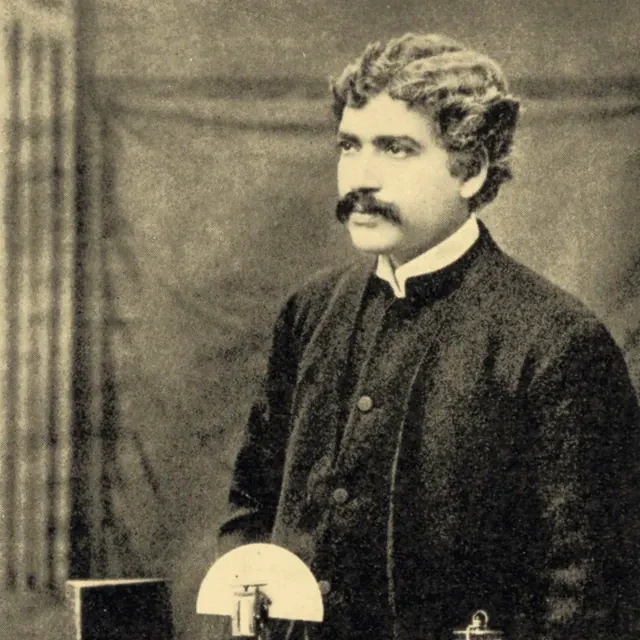
Start with the price tag
The government offers the new physics professor at Presidency College one-third of what an Englishman earns in the same chair. Same syllabus, same students, same blackboard — a third of the wage. Most men negotiate. Some resign, loudly, and are forgotten by spring. Bose does the thing nobody budgets for: he teaches the full load and refuses to draw the salary at all. For three years the college keeps a ledger line open for a man who will not collect an insult.
Three years. Every class taught, every paper marked, and not a rupee taken. The college blinks first — full pay, full arrears. And notice what he has actually won, because it is not money: he has established, in writing, in the empire’s own accounts, that the price of an Indian scientist is not for the empire to set.
The episode — Nothing Stops HimThe tinsmith and the invisible light
Now imagine the kind of materials he would need. There is no instrument industry in the whole country — that is not an accident, it is the design: India digs, Britain manufactures, India buys back at markup. A scientist in a colony is supposed to be a grateful consumer of apparatus, the way the country is a consumer of cloth.
So he manufactures the tools, then manufactures the science. A Calcutta tinsmith at his elbow, galvanised iron and brass where Cambridge would order catalogue parts. In 1896 he stands at the Royal Institution in London and bends, reflects and polarises invisible waves in front of the men who run the world’s science — on instruments a colony was never supposed to be able to make. The room came to be impressed by a clever Indian and left a little unsettled, because what they had watched was not a clever Indian. It was a peer.
The patent he let lapse
A wireless manufacturer comes for the detector. He knew exactly what it was worth — the patent is filed, once, under pressure from an American friend, and then he lets it die on the shelf. His position, plainly: the knowledge belongs to everyone or no one, but not to a company. You can call that unworldly. He would have said he was simply refusing to own the airwaves — and then he turned around and spent thirty years proving the same refusal could run an institution.
Because that is the pattern that matters. The salary refused, the patent lapsed, and in 1917, on his own birthday, the institute — his honours, his savings, poured in and signed over to a nation that does not legally exist yet. He called the building a temple, not a laboratory, and he meant the difference exactly: a laboratory is where you work; a temple is where you give yourself to something larger and walk out smaller and more useful.
The field that was alive
Then he turns from metal to life, looking for the line where physics ends and the living thing begins — and reports back that he cannot find it. The crescograph magnifies a plant’s movement ten thousand times: stems grow, flinch, tire, recover, answer shock like a nerve. Take the most patronised thing in the empire’s imagination — the silent, patient, exploitable Indian field — and show the world it has been alive and feeling the whole time. He never says the parable out loud. He never has to.
He works until 1937 and finishes at the bench in Giridih, mid-sentence. No retirement, no farewell tour. The temple he raised keeps running to this day.
Where this thread runs
A life, dated
- 1858Born in Bengal; the Crown takes the country from the Company the same year. His father, a deputy magistrate, sends him first to the village school — the cover story.
- 1885Appointed to Presidency College; offered one-third of an Englishman’s salary. Refuses to draw it for three years, and wins full pay with arrears.
- 1894–96Builds his own apparatus with a Calcutta tinsmith; demonstrates invisible waves, London included — the pilot episode.
- 1904Files the one patent of his life — then deliberately lets it lapse.
- 1917Founds the Bose Institute on his own birthday and hands it to the nation — S2 · E5.
- 1928–30In the rooms of the 1876 farm, Raman — the crop Sircar and Bose’s generation raised — takes the first science Nobel of the subcontinent.
- 1937Dies at the Giridih bench. Never retired; finished mid-sentence.
Named sources
- The episode Nothing Stops Him (S2 · E1) — the salary ledger, the tinsmith, the Royal Institution demonstrations.
- The episode record, A Temple, Not a Laboratory (S2 · E5) — the 30 November 1917 founding and endowment.
- Primary and period sources, named in full on each episode’s own source list.
House rule: numbers arrive with their author’s name attached, and we correct in public. The method is on the About page →