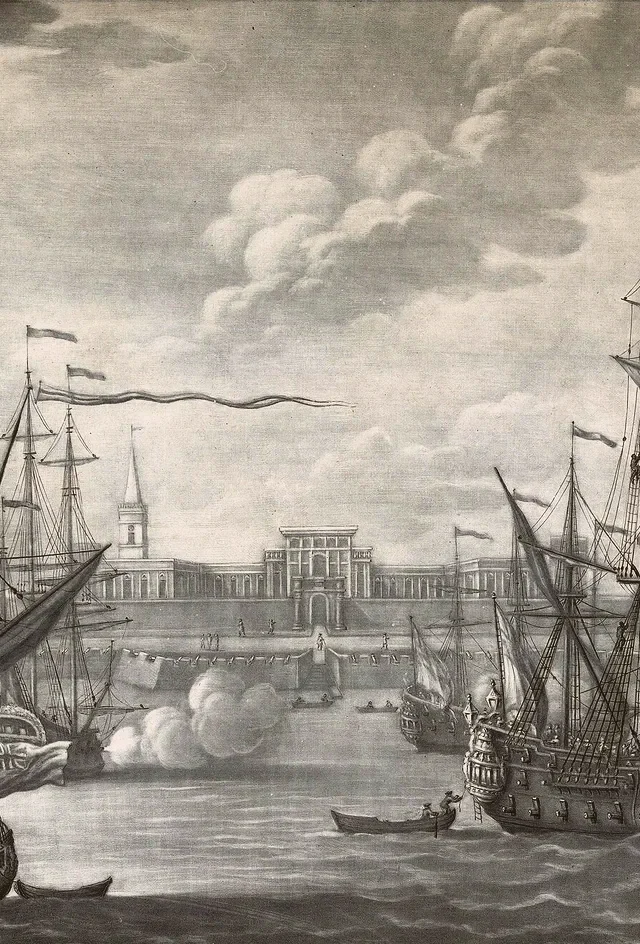
Watch the sequence, because it repeats on every coast of the planet. 1613: the Company gets permission from the Mughal emperor to open a factory at Surat — a factory in the old sense, a depot where goods wait for ships. 1639: a Company agent leases a strip of sand on the Coromandel coast and builds Fort St George; the town that grows around it will be called Madras. 1668: Bombay — which the Portuguese crown had literally handed to England as a wedding present — is leased to the Company for ten pounds a year. 1690: an agent named Job Charnock pitches on a malarial riverbank in Bengal, and Calcutta begins. Four warehouses. Four future capitals of empire.
No one plans a colony — that’s the trick of it. Each step is a reasonable business decision. Pirates raid the goods, so you fortify. The fort needs soldiers, so you recruit sepoys — local men, Company pay. Weavers and merchants and moneylenders settle under the walls because the Company pays in silver and the courts inside are predictable, and now there is a town. The town needs revenue, so the Company collects rents and duties — and quietly, without a single declaration of war, a firm of merchants is now governing tens of thousands of Indians. Ask yourself what the board in London sees: not conquest. A cost centre becoming self-funding.
Nobody voted to build an empire. It compounded, the way interest does.
And the walls kept being justified. Europe’s wars kept arriving on Indian water — Dutch against Portuguese, English against French — and every round of cannon fire made the next wall thicker and the next garrison larger, until the trading companies of Europe sat on the coasts of India like armed banks. By 1740 the Mughal centre is buckling under its own succession wars, the provinces are auctioning loyalty, and the Company’s recruiters have noticed something with compound-interest consequences: a sepoy army, drilled the European way and paid on time, beats a bigger army that is paid late. File that. The machine has just discovered its killer feature — payroll discipline.
This, in the same years, is the India the machine is measuring: still weaving the world’s cloth, still growing a giant share of the world’s output, its wealth walking into the warehouses one bale at a time. The customer at the gate has become the landlord of the porch. And upstairs, the house is quarrelling.
A warehouse with a wall is still called a trading post. But teach it to collect rent and drill an army, and you have built the prototype of a state — you've just not filed the paperwork yet. The paperwork comes at Plassey.