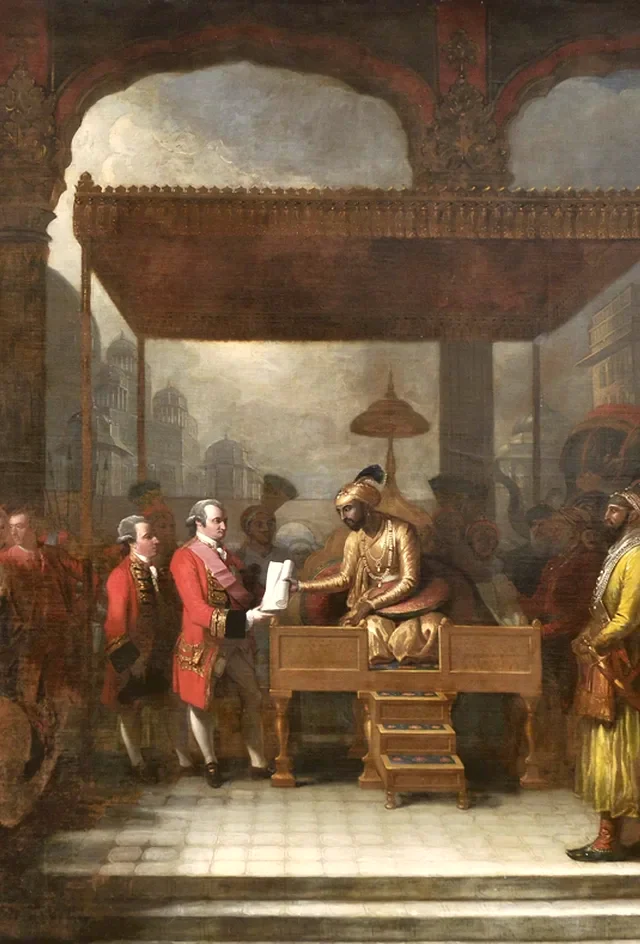
Understand Plassey as a transaction and everything after it makes sense. The Nawab of Bengal, Siraj-ud-Daulah, has taken Calcutta and threatened the machine’s richest node; the machine responds not with a war but with a deal. Robert Clive finds the Nawab’s own general, Mir Jafar, and offers him the throne in exchange for standing still. The Jagat Seths — the biggest bankers in Bengal, men whose credit lines reach every treasury in the province — underwrite the arrangement, because the Company looks like a better counterparty than their own prince. On the day, most of the Nawab’s army simply doesn’t fight. Bengal, the richest province of the richest country of the old world, changes management for the price of one bribe.
Seven years later at Buxar the arrangement is stress-tested. This time it is a real battle — the Mughal emperor himself, the Nawab of Awadh, the Nawab of Bengal, allied against the Company — and the Company’s payroll-disciplined sepoy army wins outright. Now watch the machine make the smartest move in its two-hundred-year life. It does not sack Delhi. It does not crown a governor. In August 1765, at Allahabad, it makes the defeated emperor sign a lease: the Diwani — the right to collect the land revenue of Bengal, Bihar and Orissa — assigned to the East India Company, in exchange for a fixed annual payment. A shop has just acquired the tax base of thirty million people.
Loot you carry once. A tax arrives every year, forever, and calls itself law.
Feel what changes in the accounting, because this is the hinge of the whole century. Before 1765, the Company ships silver into India to buy its cloth and saltpetre. After 1765, it doesn’t need to. It buys Indian goods with Indian taxes — the revenue of Bengal purchases the cargo, the cargo sells in London, and the profit stays there. Bengal is now paying for its own drain. Economists will spend a century naming this politely. A farmer in Murshidabad would have named it faster: the landlord has changed, the rent has doubled, and the rent leaves the country.
Five years after the Diwani, the rains fail. Famine takes a third of Bengal — that is the contemporary estimate, written by the Company’s own men — and the revenue collection for that year rises. Sit with that pair of facts. The machine is not cruel the way a tyrant is cruel; it is worse, it is indifferent the way a spreadsheet is indifferent. The tax is due. The tax is always due. London, slightly embarrassed, begins passing acts to ‘regulate’ the Company — 1773, 1784 — which is to say: the state is slowly buying into the machine, not shutting it down. The machine is too profitable to kill. It will take a war to even change its nameplate.
Every empire before this one wanted your gold, your city, your crown. This one wanted your revenue department — and kept the crown on your head so the receipts stayed legal. It is the quietest conquest in history, and the most complete.