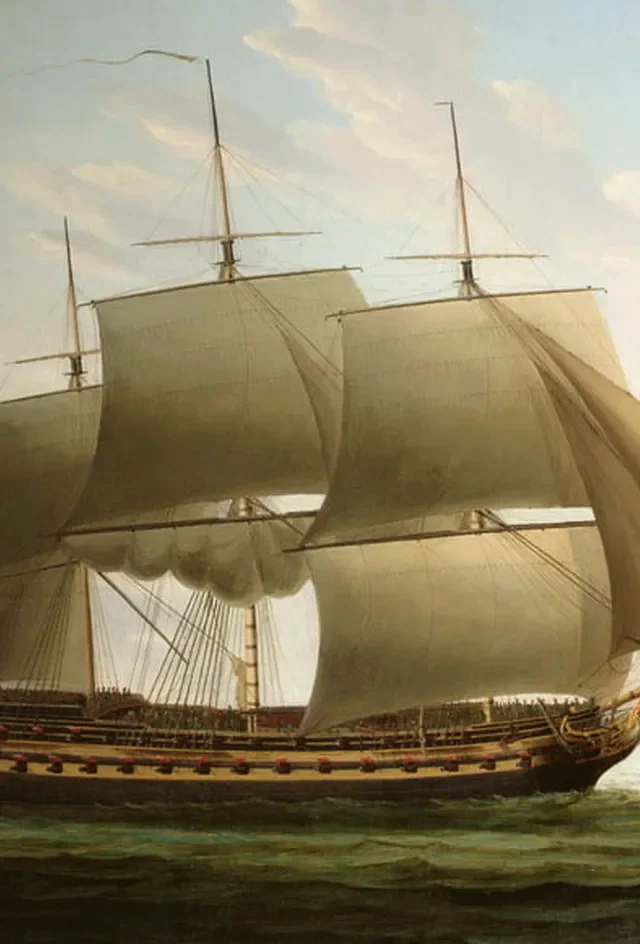
Start with what the paper actually says. The charter of the East India Company doesn’t just permit trade — it grants a monopoly on all English commerce east of the Cape, the right to carry cannon, the right to make war on anyone who isn’t Christian, the right to hold territory. Two hundred and eighteen investors put in their money the way you’d seed a startup, and the Crown puts in something better than money: permission. Permission to be a state wherever the map ran out.
And London isn’t even first. The Dutch charter their own machine two years later — the VOC, 1602 — and go one step further: they invent the tradable share. Any burgher in Amsterdam can now own a slice of a war fleet the way you’d own a slice of an index fund. The French follow in 1664. Denmark, Sweden, Portugal — everyone with a coastline files a charter. Understand what has happened here, because your school book filed it under ‘the Age of Exploration’ and moved on: Europe has invented a machine that converts private savings into naval power, and naval power back into private returns. The corporation is born, and it is born armed.
The sailors came with ledgers. The explorers were the advance team of the accountants.
Why did the ships sail at all? Because a hundred years earlier Vasco da Gama had rounded the Cape and deleted three middlemen in one voyage — the pepper that cost a fortune after passing through Venetian and Arab and Ottoman hands could now be bought at the source. Say you’re an investor in 1600: the pitch is spice margins of several hundred percent per voyage, if the ship comes home. The charter company is the instrument that spreads that ‘if’ across many ships, many voyages, many pockets. Risk pooled, violence licensed, profits compounding. It is the best financial product of its century, and India — whose muslin, calico, saltpetre and pepper are the reason the route is worth the voyage at all — doesn’t yet know its name is on the term sheet.
Hold the frame before we move. In 1600, India and China tower over the world economy; Europe is the scrappy underfunded edge. Nobody in Agra or Beijing loses sleep over a few hundred merchants in a cold northern city. That is precisely what makes the machine invisible. It doesn’t arrive as an invasion. It arrives as a customer.
A queen signs, a shop sails, and the age of armed shopping begins. For a hundred and fifty years the machine will stay polite — a customer at the gate, asking to buy. What it is actually doing is measuring the house.