The spark is a cartridge, but nobody sane believes a cartridge burns down a subcontinent. By the 1850s the machine has stopped even pretending to be a tenant. The Doctrine of Lapse swallows princely states whole — die without a male heir the Company recognises, and your kingdom ‘lapses’ to the firm. In 1856 it deposes the Nawab of Awadh outright, a kingdom that had been its loyal supplier of sepoys for a century — and every sepoy from Awadh, which is most of the Bengal army, learns that loyalty buys nothing. The land settlements have squeezed the peasant; the courts run in a foreign tongue; the missionaries are loud; and now comes a rifle cartridge greased, the barracks say, with the fat of cow and pig — one insult, engineered to reach every soldier of every faith through his own teeth.
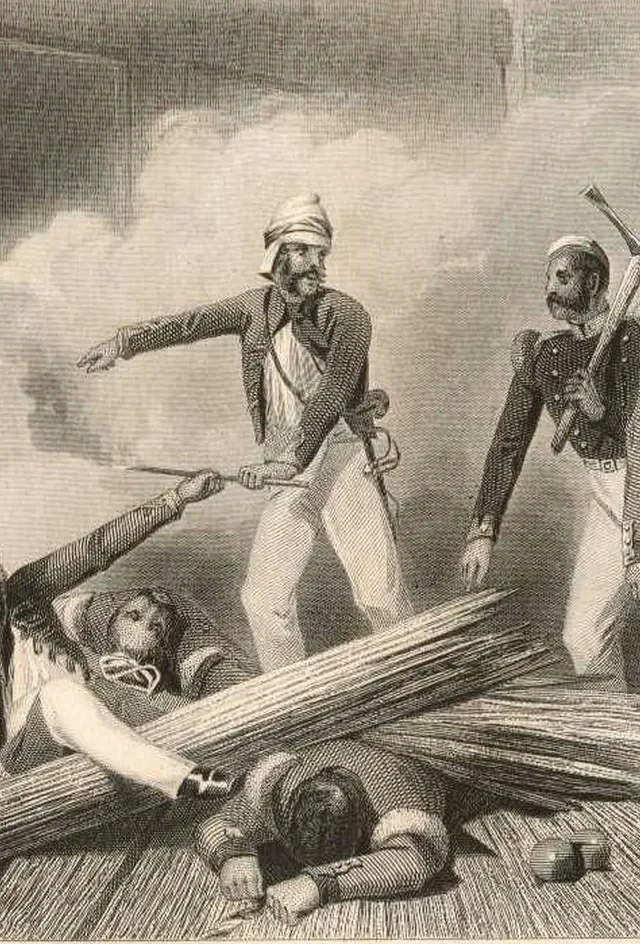
Meerut, the tenth of May: the garrison shoots its officers, marches on Delhi, and by morning has done the one thing the machine cannot survive being seen — it has put a real emperor back on a real throne. Bahadur Shah Zafar, eighty-two years old, a poet who wanted no war, becomes the reluctant flag of a rising that runs from Delhi to Kanpur to Lucknow to Jhansi. Sepoys, taluqdars, dispossessed princes, peasants crushed by the settlements — the machine’s victims discover each other. For a whole season the ledger empire actually stops. No revenue moves on half the map.
They fought the world’s first corporate state with its own trained army. It took the empire eighteen months, and every reserve it had, to win.
The reconquest is savage in a way the record does not soften — Delhi stormed and emptied, Lucknow shelled street by street, rebels blown from the mouths of cannon so that the lesson would carry. Read it plainly and read it whole: the machine wins because the risings never fuse into one command, because the Punjab and the south stay quiet, because the telegraph — the Company’s newest wire — moves faster than any horseman carrying the revolt. The men of 1857 do not lack courage. They lack the machine’s two secret weapons: coordination and cash flow. Remember this gap. Everything our library calls the relay — the farm, the schools, the laboratories, the industries — is one long, patient project to close it.
And then the paperwork, because with this machine it always ends in paperwork. August 1858: the Government of India Act — the Company is abolished, its army, its territories, its debts transferred to the Crown. November: the Queen’s Proclamation, read out at Allahabad, all velvet — no more annexations, princes secured, faiths respected. The desks do not move. The files do not move. The tax does not move. What changes is the operating doctrine: never trust a unified sepoy army again, so re-balance it and salt every regiment with division; never touch the princes again, so freeze a third of the map as museum kingdoms; and rule henceforth from behind a racial wall, because 1857 taught the ruler to fear the ruled. That fear-hardened, divide-ruled, tax-running arrangement — that is the India of 1858.
The machine survives the sword and changes its nameplate, and history books call the year an ending. Look again. In November of that same 1858, in a magistrate's house in Bikrampur, a boy is born — and the men who saw the machine from inside are about to stop asking how to break it, and start asking how to out-build it. That story is Season One. This was only the soil it grew in.