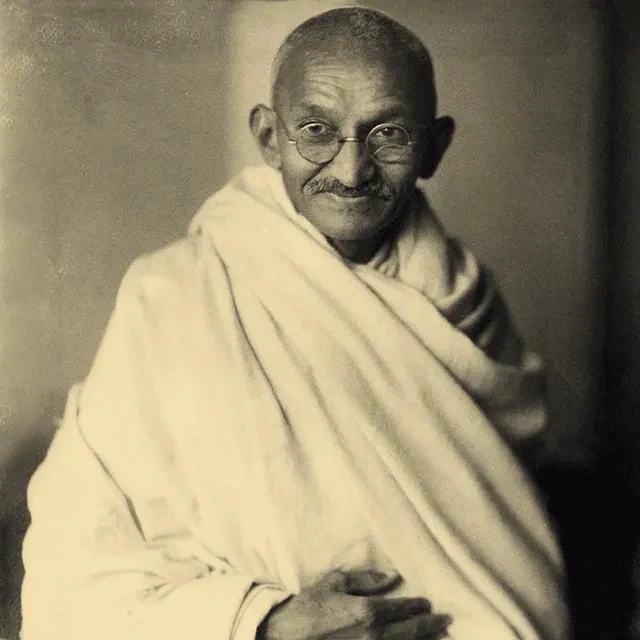
Start with the problem, because the problem is the entire story and almost nobody states it. Three hundred million people. No radio. No television. No national broadcast of any kind — nothing at all that lets one man be heard inside a room he is not standing in. A country stitched together out of railway lines and post offices and princely states and languages that do not always agree with one another. And within a few years of 1915 that country cannot stop watching one particular man, and cannot stop asking what he will do next.
Now do the arithmetic. How does a face get from one harbour to three hundred million people in a world with no wire to carry it? Charisma does not travel. Charisma has to be carried — by a press, a platform, a host, an introduction, a man who already knows the next man — and every one of those things is built by somebody, paid for by somebody, or simply opened at the right hour by somebody who had no particular reason to open it.
So the honest question was never how he became beloved. It is how he became visible — and the answer to that is not a miracle and it is not magnetism drifting over the subcontinent like weather, it is an explanation with names in it.
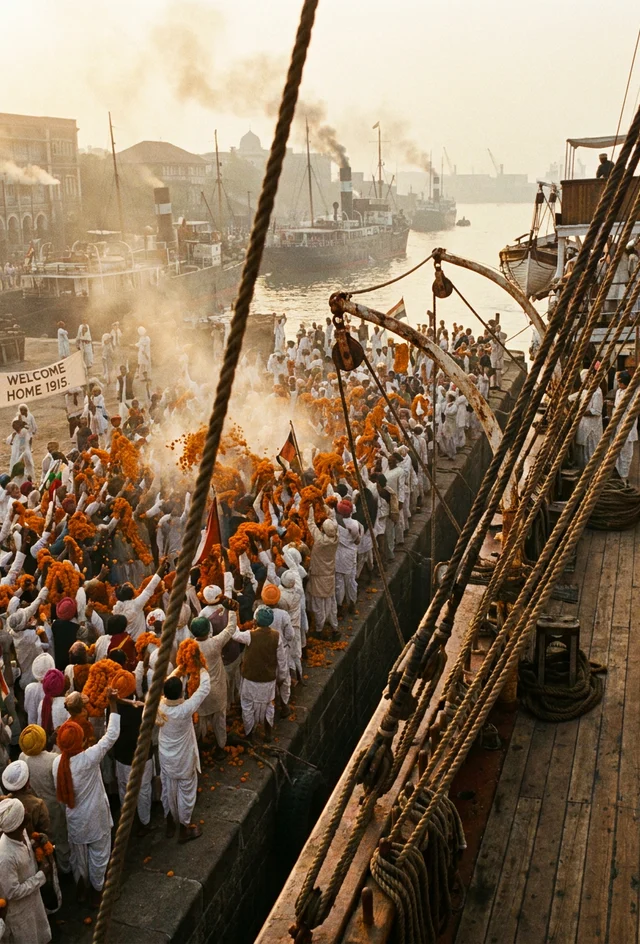
Half past seven in the morning, 9 January 1915, Apollo Bunder. Mohandas Karamchand Gandhi and Kasturba come down a gangway after more than two decades tied up in South Africa, and the story we are all handed begins here: India receives Gandhi, Gandhi goes around India, India discovers Gandhi, and eventually — Mahatma. Lovely. Now look at what the man actually does with his first day.
He does not walk off that pier and start asking strangers where one finds Indian politics. He goes to a house — Revashankar Jhaveri’s house, which means somebody knew which bed he was sleeping in before the ship docked. That same day he sees Gopal Krishna Gokhale and V. S. Srinivasa Sastri at Narottam Morarji’s home. That same day he gives interviews to the Bombay Chronicle and the Times of India, in which he says he intends to take Gokhale’s advice and spend some time watching India before he acts on it. One day. Ship, house, Gokhale, Sastri, two newspapers.
He was unknown to millions of Indians. He was not remotely unknown to the machinery through which a public man in India became visible, and that distinction is the whole file.
Keep the calendar open. On the 12th he sees Dadabhai Naoroji, and that evening there is a reception at the Petits’ with Sir Pherozeshah Mehta in the chair. On the 13th, a National Union meeting — Tilak in the room, Joseph Baptista in the room. On the 14th he calls on Lord Willingdon, the Governor of Bombay, then goes to a reception of the Gurjar Sabha chaired by M. A. Jinnah, and then to the Servants of India Society. On the 15th, Gokhale again.
Six days. That is not fame yet. It is something a great deal more useful than fame, and it is the thing fame is built out of: access, rooms, platforms, newspapers, hosts, men whose names already travel — and at every stop, somebody has quietly opened the next door. Which proves nothing about a committee. It proves something much less romantic and far more interesting. The doors existed. And this man moved through them at a speed that ought to make anyone sit up.
There is a second problem with the picture of a solitary man arriving alone, and it is a small, hard, awkward fact: part of his operation reached India before he did. While Gandhi was held up abroad, the group from his Phoenix Settlement had already sailed, and he had to put them somewhere. So he wrote to C. F. Andrews, and Andrews placed them first at Gurukul Kangri, where Swami Shraddhanand took them in, and then at Santiniketan. Tagore’s institution. Read that again slowly. Before the man ever set foot on Apollo Bunder, people formed inside his South African experiment were already being absorbed into Indian institutional networks.
The principal is still at sea. His people are already in the building.
And then there is Gokhale, whom the tidy version of this story hands to Gandhi like a gift — the returning son, thoughtfully supplied with a mentor. No. Look at the direction of travel. In 1912, three years before Bombay, Gokhale went to South Africa, at Gandhi’s invitation. One of the senior political figures of India crossed an ocean into Gandhi’s theatre, moved through it in a special railway saloon, was met by reception committees and mayors and officials, spoke at public meetings with thousands assembled at some of the stops — and it was Gandhi who travelled with him, Gandhi who introduced him, Gandhi who walked him into the Indian communities he had spent years organising.
So when the two of them sit down together on the day the ship lands, that is not an interview. It is not a newcomer being taken up. It is a circuit that was wired in 1912 closing in 1915. Which is a relief, frankly, because now we do not have to invent a machine. Parts of it are standing right in front of us with their names on.
And here is the part that gets left out of every retelling, because it is unglamorous and it is work: the man coming down that gangway had already spent years inside a political communication system, and he had been the one running it.
Indian Opinion starts publishing in South Africa in 1903. Not a pamphlet — a going concern. A printing press, editors, typesetters, bundles, addresses, subscribers. English and Gujarati, and at different stages Hindi and Tamil. When the struggle sharpened, circulation ran into the thousands, and Gandhi later described the paper as one of the instruments through which news of the campaign moved through the community. Instruments. His word.
And it was physical, all of it. Copy written. Type set. Pages printed. Sheets cut and folded. Addresses pasted. Bundles made up. Saturday dispatch. Somebody had to do every one of those things every single week, and the man who ran that shop understood in his hands what most politicians only understand as a theory — that a grievance does not travel on its own. It has to be moved: from one injured person to a newspaper, from the newspaper to a community, from the community to a meeting, from the meeting to a government, and from the government straight back into another round of publicity. That is a circuit. He had been running it for years.
India was bigger. India was very much bigger. But the verbs were the same ones, and he already knew them.
Watch February. Ahmedabad receives him publicly; he stays with Seth Mangaldas Girdhardas and dines with Ambalal Sarabhai. Poona gives him a municipal reception, he calls on Tilak, the Sarvajanik Sabha receives him. On the 17th he is at Santiniketan, where Andrews is waiting, and where he meets Kaka Kalelkar and J. B. Kripalani for the first time — two men who will still be in his political world decades later. Two days after that Gokhale dies and he leaves for Poona. He is back at Santiniketan in March, and this time he meets Tagore. Then Calcutta, on the 12th, where the crowd unharnesses the horses from his carriage and pulls it themselves, and Kadambini Ganguly receives him on the way at the Sadharan Brahmo Samaj. The next day, another reception. More public men, more organisations, more rooms.
Bombay, Rajkot, Ahmedabad, Poona, Santiniketan, Calcutta. Newspapers, political societies, industrial households, reform institutions, educational institutions, the leaders already standing and the associates not yet made. January, February, March. Three months.
None of this proves a hidden panel picked a man and launched him, and we are not going to pretend it does. There is no letter that reads Gentlemen, we have selected Mohandas Gandhi, please manufacture a Mahatma. If that letter turns up, bring it and we will read it out loud. Until then, leave the imaginary ledger alone, because the documented machinery is already better than the fantasy. A host knew which bed he would sleep in. A newspaper knew to send somebody down to the harbour. Gokhale knew him before he landed, and Gokhale’s people were waiting when he did. Political organisations gave him platforms; industrial families opened their houses; Andrews already had his Phoenix men parked at Santiniketan, and so Tagore’s world and Calcutta’s reformers came into contact with a man most of them had never met. And at every one of those stops the man himself turned access into attention, which is the part no network on earth can do for you — a door can be opened for anybody, and the room still empties if you are dull. He had spent twenty years learning how to make it not empty.
So the title is carrying the wrong mystery. He did not come from nowhere. South Africa is not nowhere. Phoenix is not nowhere. A press that ran in Gujarati and in English, and in Hindi and Tamil at different stages, is not nowhere. Gokhale is certainly not nowhere, and neither are Andrews, the Petits, Mehta, Naoroji, Tilak, Jinnah, the Sarabhais, Santiniketan, Tagore or the Brahmo Samaj. The miracle only shows up when biography deletes the infrastructure — take away the addresses, the hosts, the newspapers, the printing press, the introductions, the railway platforms, the receptions and the men who already knew the next man, and yes, of course, a Mahatma appears out of thin air.
Put the machinery back and something better appears. Not a command room. A distribution system for political legitimacy — some of it built by Gandhi himself, some of it older than him, some of it belonging to people whose politics were nothing like his. Some of those relationships were deliberate mentorship. Some were hospitality. Some were publicity. Some will turn out to matter more than they look. And some of it may be nothing at all except the ordinary circuitry of elite Indian public life in 1915, and that possibility stays on the table, because a question you have already answered is not a question.
Because the thing to ask was never whether one hand opened every door. It is how many doors had to open before three hundred million people could even begin to see the man standing behind them. So: who arranged each reception? Who wrote ahead? Who supplied the addresses? Who called the newspapers? Who paid for the travel? Which introductions came through Gokhale, which through Andrews, which existed on their own? Which names keep coming back? Which of these institutions turns out to be useful again later? And at what exact point does a man known inside these rooms become a man known outside them — where, precisely, does the amplification happen?
That is the file worth opening. The Mahatma did not come from nowhere — what is interesting is how much machinery you can see the moment you stop pretending he did.