Each season of the century in one breath — for the day you have ninety seconds and still refuse to scroll garbage.
The Cover Story · 1876
Four things happen at once
IACS opens at 210 Bowbazar Street — a science institute with no government money. J.C. Bose turns exactly eighteen. The telephone is patented. And the Great Famine of 1876–78 begins killing its millions. The farm is dug while the bull is on the killing floor. Four switches, one year — and the honest question is which of them are connected to each other and which only share a date.
A country with no spine watches the Crown take direct rule. A doctor, a schoolmaster, and a magistrate — men inside the machine who can see exactly how it grinds — refuse to join it officially and start building the thing the country actually lacks: a farm that raises talent. Five episodes, ending at a temple in Bowbazar that isn’t a temple at all.
The first crop walks in the gates: Bose refusing a rigged salary for three years, building instruments with a tinsmith because the empire won’t sell him any, showing the Royal Institution invisible light, letting the patent lapse, and handing his institute to the nation on his own birthday. Nothing in the world stops him.
An all-white commission decides the fate of 300 million and unites a furious country. Lajpat Rai is beaten and dies. And in the same five years — in Sircar’s house — Raman finds why the sea is blue, Saha reads the temperature of stars from Calcutta, and Stockholm hands the subcontinent its first science Nobel. Sovereignty of the mind, proven before the political kind is won.
A 61-year-old walks 240 miles to make a fistful of illegal salt, and the one grievance shared by 300 million erupts coast to coast. Tens of thousands jailed, the women at the front, the Depression twisting the old land-tax knife, a truce, and eighteen days later three young men hang. And on the sidelines, the farm keeps cropping the self-reliance the politicians were only demanding.
A man posts back the empire’s best career and reports to Gandhi the day he lands. Twenty years of prisons later he starves the Raj into opening his cell, walks down his own back staircase in a fez, and is driven all night up the Grand Trunk Road by a twenty-year-old. Two years on he stands in Singapore with a government, an army, a women’s combat regiment — and an oath that promises recruits nothing but hunger, thirst and death. They queue.
An orphan takes a dead Scotsman’s free bench in 1840 and grows up to build India’s first science institute. A magistrate seats his son between a fisherman’s boy and a servant’s boy — the boy becomes the first great Indian physicist, carried to school on a reformed pirate’s shoulders. A village library outlasts a declining estate and yields the chemist who builds India’s first pharma. A grocer’s fifth child turns four rupees a month into the equation that reads the stars. And on an Ahmedabad lawn, a mill fortune hires twelve teachers and builds a foundry for eight children — and the lawn returns a space programme.
Legends are not born. They are staffed — by parents, patrons, free benches and libraries. Every episode of the course is on the walk.
A professor starts a drug factory with seven hundred rupees against doctors who trust only London labels — it is still trading. A railway commissioner promises to eat every pound of steel the Indians make — eight thousand small subscribers answer with £1.63 million in three weeks, and the empire’s armies ride to war on Indian rails. A contractor hears on a train that a ship is for sale, buys it, and puts the first Indian flag on the ocean run to London through a rate war of eighteen rupees cut to six. A perfume seller records Tagore’s voice on wax; a children’s author teaches London how to print photographs.
The freedom struggle had a capital front, and these are its regiments. Every campaign is an episode on the walk.
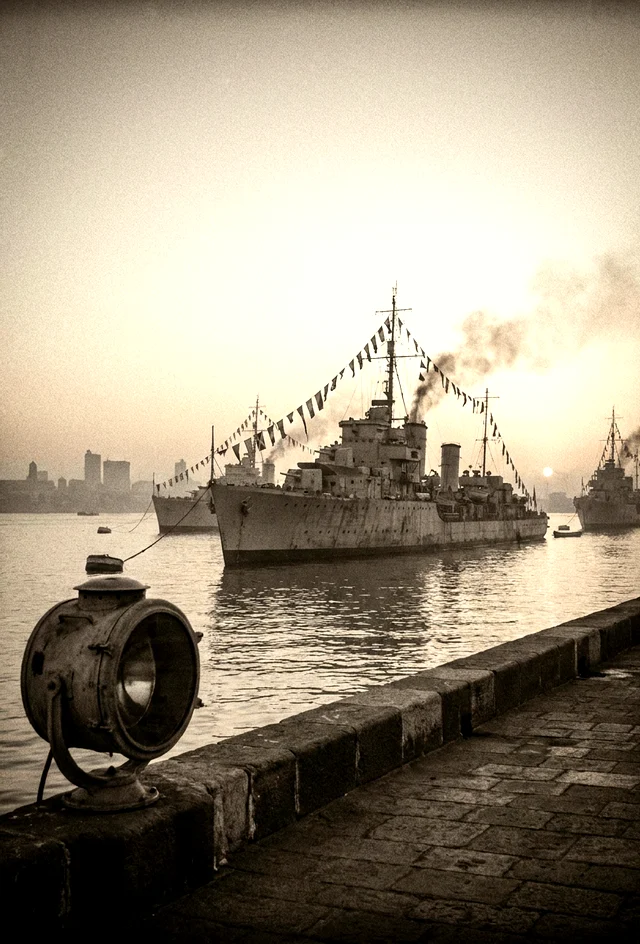
The empire tries its lost army in the Mughals’ own fort — one Hindu, one Muslim, one Sikh in a single dock — and turns three convictions into a national monument. Three months later the King’s own navy flies mutiny flags in Bombay harbour and surrenders to a Congress politician, not an Admiral. Eighteen months after that, a civil servant from Malabar drafts the transfer of power in two or three hours. They came to trade; they stayed to rule; they left without a war or a treaty.
1885: a retired British official convenes the Indian National Congress as a safety valve. 1892: Naoroji wins a British parliamentary seat by three votes and argues India’s case inside the Commons. 1906: he says swaraj from the chair and the word cannot be recalled. 1919: Amritsar ends the argument that reform will arrive on its own. 1930: salt turns a lawyers’ party into a mass movement. 1936–39: fifty thousand miles of villages turns it into a party that wins provinces. 1942: an army is handed over in a Singapore park and stops being reliable. 1945: the Red Fort trials make the unreliability public. 1947: a transfer of power drafted in two or three hours.
The through-line: nothing was conceded to argument alone, and nothing was won by force alone. What moved was the empire’s estimate of what it could still count on.
1876: Mahendralal Sircar opens a laboratory on public subscription — “solely native, purely national.” 1895–99: J.C. Bose builds millimetre-wave apparatus with a Calcutta tinsmith and demonstrates it at the Royal Institution. 1892: P.C. Ray starts Bengal Chemical Works with seven hundred rupees; the limited company follows in 1901. 1920: Saha’s ionisation equation makes stellar spectra readable. 1924: S.N. Bose posts a paper to Einstein, who translates it himself. 1928: Raman finds the effect; the Nobel follows in 1930. 1938–42: D.M. Bose and Bibha Chowdhuri find heavy-meson tracks in exposed plates in the Himalaya. 1948–56: the atomic energy apparatus is built.
The through-line: every one of these was done on inadequate equipment, in a country whose government did not think Indians did fundamental science, by men and women who built the institution first and the result second.
One card, one curve — home charges leaving India, as Naoroji himself computed and published them. £5.3 million a year averaged across 1835–39. £17.3 million across 1860–64. £27.4 million across 1870–72. Around £500 million cumulative to 1872, before interest. By 1901 he puts the annual bleed at nearly or above £30 million. Set against a production of about forty shillings a head — two pounds a year, per person, across a hundred and seventy million people.
Six numbers, all of them his, all published, all checkable. That is why the argument outlived him. Every figure here is in sterling as he wrote it; any rupee rendering you see elsewhere is a later conversion, not his wording.
What the Indian Army was doing after 15 August 1945. Saigon: 20th Indian Division in; martial law 19 September; French prisoners rearmed on the 22nd; Viet Minh offices seized and handed over on the 23rd. Java: 49th Brigade into Surabaya 25 October, Mallaby killed on the 30th, the city assaulted from 10 November. Semarang and Ambarawa: Indian brigades relieving Japanese troops who had been guarding Dutch internees. Bekasi: a Dakota down on 23 November, then a burning nobody dates the same way twice. Bandung: an ultimatum in March 1946, and a city set alight by the Indonesian side evacuating it — not by British or Indian troops.
Forty men of the 20th Indian Division dead in Indo-China; several hundred to over a thousand British and Indian dead in the Netherlands East Indies depending which window you count. And an estimated six hundred sepoys who went the other way and fought for the Indonesians — single advocacy source, treat as an estimate. Every casualty figure here is a range. Two years of Indian soldiers holding somebody else’s empire together, while their own was being negotiated in London.
1813–29: sati is regulated, then abolished after Rammohan Roy proves from the scriptures that the practice has no authority in them. 1829–41: hereditary strangling on the trunk roads is ended by a card index. 1836 onward: human sacrifice in the Khond hills is argued down over thirty years rather than shot down. 1849: Bombay students decide to teach girls themselves rather than petition for schools. 1856–76: Vidyasagar forces widow remarriage through and opens thirty-five girls’ schools. 1859–93: the ICS age limit and London-only venue keep Indians out without ever saying so. 1876: a laboratory opens on public subscription. 1916–23: Asutosh builds a research university and then refuses to keep it on the government’s terms.
The through-line: almost nothing on this list was granted. It was argued for, in the reformers’ own scriptures and the rulers’ own arithmetic, and then built before anyone said yes.
1912: a Head Clerk of the Forest Research Institute at Dehra Dun runs the network that bombs the Viceroy in the Chandni Chowk. Four men hang. He walks. 1914: he hides a year in Benares, exercising only at night, because the police hunting him do not speak Bengali. Feb 1915: he plans a general rising across Upper India — cantonments, flags, a declaration of war — and loses it in four days to one informer. Jun 1915: he reaches Japan on a borrowed name and never sees India again. Dec 1915: a Tokyo bakery hides him past his own deportation deadline. 1923: naturalised Japanese. 1931: founds the first Indian Independence League. 1942: convenes Tokyo and Bangkok, demands Japan call India independent, gets silence. Jul 1943: hands the League and the army to Subhas Chandra Bose. Jan 1945: dies in Tokyo, fifty-eight.
No relation by blood. He built the instrument and gave it away, and his son died at Okinawa in Japanese uniform five months after him. He is better known in Japan than in India.
1866: Orissa — grain rots in ships off a starving coast while doctrine holds that the market will provide. 1877: Temple sets a relief wage below what the government’s own medical officer says a working man can survive on; the objection is minuted and overruled. 1880–83: the Famine Code is written — graded stages, checkable triggers, a category for everyone, and a rule that you must walk ten miles to prove you mean it. 1942: forty-five thousand boats are taken out of the Bengal delta to deny an invasion that never comes. 1943: famine is never declared in Bengal, because declaring it switches on obligations nobody intends to meet. 1945: the Woodhead Commission finds the tragedy was largely preventable.
The through-line, and it is not incompetence: the machinery was sophisticated, it was pointed at fraud rather than hunger, and it only ever worked when somebody was willing to pay the political price of switching it on. Every mortality figure across this century is a contested range, and this library gives ranges.
The problem: two-fifths of the landmass was not British territory. Several hundred princely states held treaties with the Crown, not with British India, and when the Crown withdrew those treaties lapsed. On 15 August 1947 the legal position was that they all became independent. The instrument: an Instrument of Accession asking for three subjects only — defence, external affairs, communications — plus a standstill agreement so that trains and posts kept running. The deadline: five weeks. The result: almost all signed before 15 August. The exceptions: Junagadh went to a referendum, Hyderabad to four days of troops in September 1948 and a silence afterwards, Kashmir to a war that has not ended. The sequel: privy purses and titles were abolished later, which the rulers regarded as a bargain rewritten after the fact.
The through-line: a country was assembled with a two-page document and a calendar rather than an army, and the one place that needed an army is also the one place the cost was never published.
1920s–30s: Indianisation admits a thin, watched stream of Indians to the King’s Commission — invited to the mess, not to command. Feb 1942: at Farrer Park tens of thousands of Indian troops are told they have been handed over to the Japanese by the terms of the surrender. 1942–45: an Indian National Army is built out of them, largely officered by men from that same interwar cadre. 1945: the Red Fort trials make them heroes and make the Indian Army’s reliability a public question. 1946: the naval ratings mutiny. 1946–49: independent India declines to readmit INA men to its army. 1947: the officers who stayed field a working army within weeks.
The through-line: the empire trained both halves of the argument, and the republic kept only one of them — for reasons that are institutional rather than ungrateful, and are worth understanding before they are judged.
1851: the Rast Goftar is founded in Bombay in the same year as the reform society it argues for — the society is the argument, the paper is the distribution. 1878: the Vernacular Press Act sets one law for Indian-language papers and another for English ones. 1883: the Calcutta English press runs the Ilbert agitation and wins. 1887: subsidised pamphlets argue that the Congress represents nobody. 1916: the Home Rule Leagues move handbills by the ton and build the first continuously operating political machine India had. 1930s: the vernacular press carries a mass movement into districts no leader had visited.
The through-line: every serious political formation in this library began by acquiring a printing press, and every government that tried to govern India eventually tried to license one.
1853: patronage is replaced by competitive examination — a genuine reform, and one that selected for elegant prose about the ancient world. The venue: London only. The age cap: pushed downward, so a candidate had to cross the sea as a boy, at a cost that ruled out anyone without capital. The effect: no rule anywhere said no Indians; the shape did the work a ban would have done. 1859–1893: Naoroji spends thirty-four years asking for one thing — the same paper, on the same day, in two rooms. The resistance: sustained, which is the tell; an equality that costs nothing to grant is only refused when it was never meant as equality.
The through-line: exclusion is written as a deadline, a venue, an age and a fee. It is still written that way, and it is still legible to anyone who reads the arithmetic instead of the intention.
1947: several hundred princely states acceded in five weeks. 1948: the Atomic Energy Commission, a year after the state existed. 1950: a Constitution, and the National Sample Survey — the first machine for asking the country what it actually earned and consumed. 1951–56: the first two Five Year Plans, the second built on a model that put capital goods at the centre. 1952: the first general election under universal adult franchise, in a country with mass illiteracy, which nobody outside India expected to work. 1956: Apsara goes critical — the first research reactor in Asia outside the Soviet Union.
The through-line: a state with almost no money spent its first decade building instruments rather than buying goods. Argue with the choices — many have — but the instruments are what every later argument has been conducted with.