The empire passes a law meant to centralize Indian universities — to make them smaller, tamer, easier to file. They hand the running of Calcutta University to an Indian, partly as damage control, expecting a safe pair of hands. They get Asutosh Mukherjee, mathematician and High Court judge, and he does something no one budgeted for. He takes the centralizing machinery built to shrink Indian science and quietly re-points it to grow Indian science instead. He doesn't smash the system. He captures it.
And then he commits the act the whole table turns on. The new Palit Chair of Physics — the best-endowed post in Indian science — and the man he wants for it is an Assistant Accountant General in the government's Finance Department, doing physics at IACS after office hours, with no doctorate and no training abroad. The trust deed's condition requires exactly that training. Raman will not go. So Asutosh has the condition itself rewritten — a dead man's endowment, amended to fit a living talent — and Raman takes the chair in 1917 at nearly half his government salary.
No speech in the Senate defending the choice survives, and the famous retort people quote is in no record anyone has produced. What survives is better. His own announcement: the University had been “fortunate enough to secure the services of Mr. Chandrasekhara Venkata Raman”, a man of “European fame” whose researches were “carried on under the most adverse circumstances”. Mr. No doctorate to cite, so he made the missing credential the argument.
Read that appointment correctly and you understand the man. He is not hiring credentials. He is hiring futures — backing a person against a résumé, rewriting the paperwork that stood in the way, betting the most prestigious post in the country on raw promise. The name he secured for six hundred rupees a month turned out to be a Nobel.
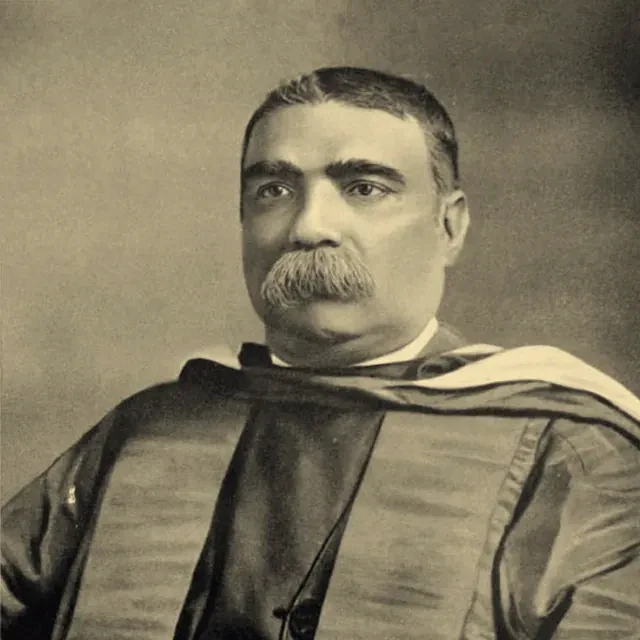
He builds the College of Science on the fortunes of two Indian lawyers, Palit and Ghosh, who pour their money into Indian minds when the state will not. He installs Ray in the chemistry chair, draws in Saha and S.N. Bose, and assembles, almost single-handed, the room in which the next generation will be manufactured. If Jagadish Bose is the heart of this story, Asutosh is its circulatory system — the man who moved the money and the people to where the work could happen.
He never discovered a law or built an instrument. He did something rarer and, for a talent farm, more necessary — he found the futures, captured the capital, and put them in the same room, and then dared anyone to tell him he'd guessed wrong.